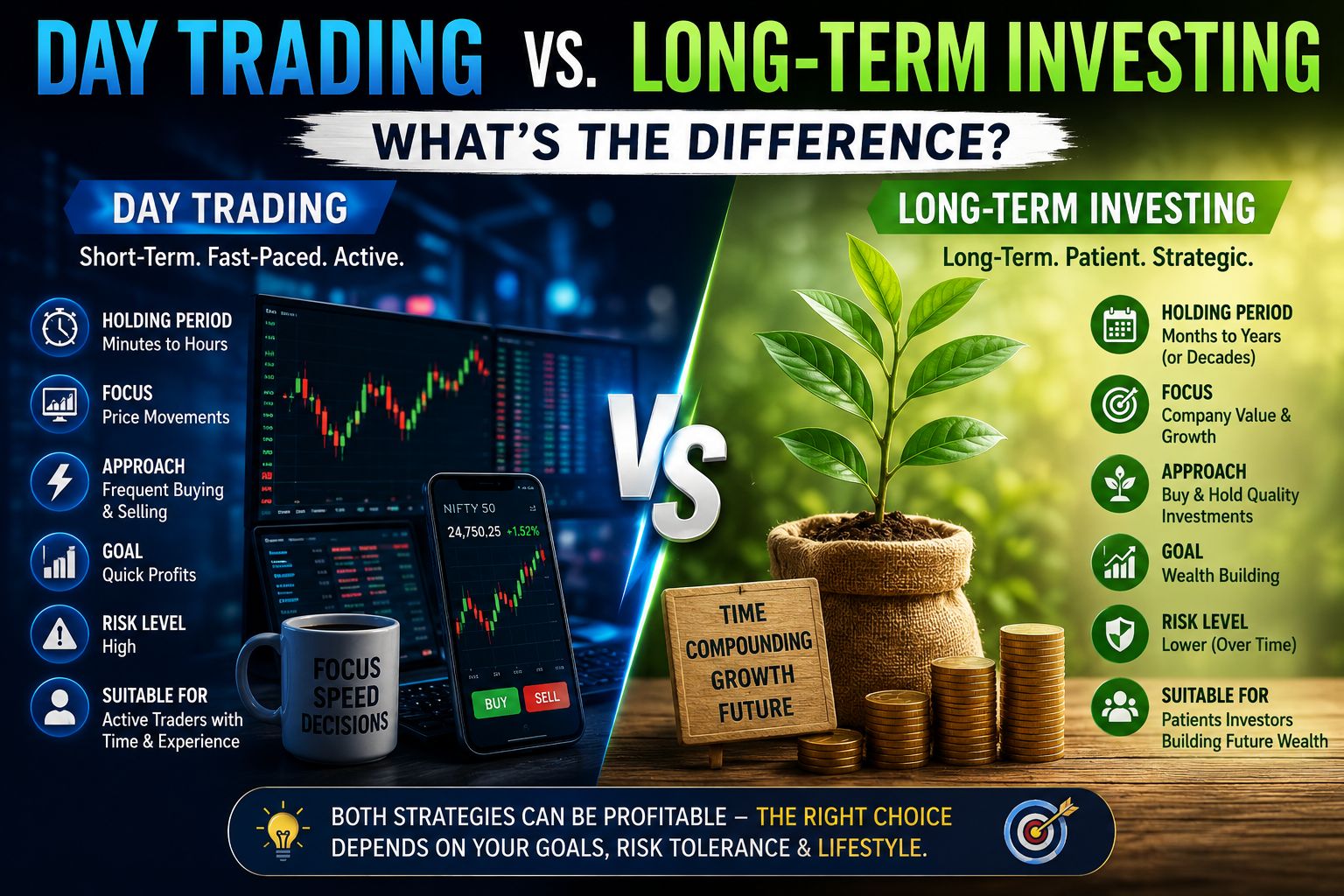
Day trading and long term investment are two very distinct methods to play the stock market. Day traders profit on swift market moves. Long term investors want to accumulate wealth over the years.
Knowing the differences might help you choose a method that suits your financial objectives, your risk tolerance, your time availability and your comprehension of the market.
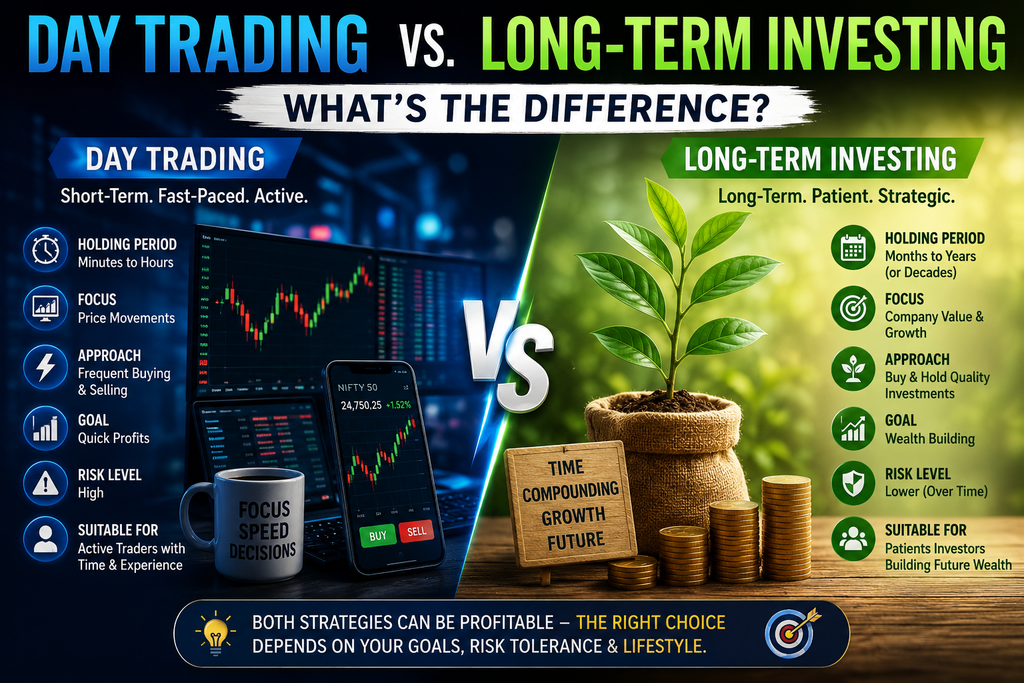
Day trading involves buying and selling stocks, indices, currencies or other financial products over a very short period of time – often the same trading day.
A day trader tries to make money from short or medium term market movements. Trading strategies differ, but usually positions are closed before the market closing.
I’ve been thinking about something for some time.
A trader finds a stock increasing and buys a stock at 500 and sells it for 515 the same day. The price movement is ₹15 (excluding applicable charges and taxes) which represents the profit potential in trading.
Permanent monitoring of the market.
What you need to day trade What you typically need:
Expertise in technical analysis
Indications and knowledge of the behaviour of prices.
Strict Risk Management
Quick Decision Making
What is long-term investing? Discipline in following a trading strategy
Buy-and-hold investing is a strategy of purchasing stocks or other investments and holding them for a period of several years or more.
Long-term investors are typically more concerned with the performance of the firm, earnings, growth prospects, competitive position, management and value – rather than the daily price movements.
Sample:
An investor bought shares of a fundamentally strong company at Rs 500 and held it for 5 years. The investor could also make money in the form of long-term appreciation in addition to dividends collected throughout the holding period as the company grows in business and the stock price crosses above ₹900.
Day Trading vs. Long Term Investing
Day trading or long-term investing? Minutes to hours, usually within a day Years or decades Principal emphasis: Price moves in the short term Business & Long Term Growth Analysis Technical & price action mainly Basic, mostly with business analysis and value Reading time: Somewhat low high Number of trades: High/Low Short term volatility significant Very significant Not usually so important Risk management is always vital in any trade. Important for portfolio allocation. Transaction charges might add up quickly. Typically lower because of less transactions Income Purpose: Goal Short term trading profits can be made Building wealth over the long run The emotional pressure is frequently intense. They are normally lower, but you can get hammered in a market slump.
What would you rather?
Best in their own manner, not everyone.
Day trading may be perfect for you if you:
Watch the markets for enough time.
study the technical analysis and market movement.
Take risks and endure losses in trade.
Discipline yourself to follow pre-determined entry and exit regulations.
No assurance of regular profitability.
If you are a long-term investor, it may work for you if you:
Looking to gently build wealth?
Have a longer-term investment horizon.
Like to spend less time staring at the market.
Are OK with investments that experience market fluctuations.
I’m looking for businesses that are growing long term.
Risk: The big difference
Both are dangerous yet the risk is different.
Day traders are dealing with a lot of price changes in a short time. If you don’t trade properly you can lose a lot of money, especially if you are using leverage or derivatives.
Even long term investing might take a major impact if the market corrects or economy sours. But longer-term investors may have more time to benefit from the growth of the business and the recovery of the markets.
Important: Past performance does not guarantee future results. Investors and traders should be aware of the risks before investing capital.
Can I get both?
Yes. Some market players adopt both strategies.
For example, a person may have a long-term investment portfolio for wealth growth and a second, smaller amount of cash for short-term trading.
But it is important to distinguish between objectives, capital allocation and criteria for risk management.
Day Trading vs Long Term Investing: Pros & Cons
The answer will rely on your financial objectives, your risk tolerance, your experience, the time you have available and your investment time horizon.
Long-term investment may be a better option if your main objective is building wealth over a long time horizon and you don’t want to be glued to the market.
If you have the expertise, time, discipline and risk management skills and understand that there is a danger of losses, then day trading could be an option – but it does require a lot more active engagement.
Concluding Thoughts
Day trading is about making a profit from short-term price movements, whereas long-term investing is about hanging onto investments for a long time to let them increase in value.
Each technique has its merits and cons, so it’s crucial to know your financial objectives and your appetite for risk before deciding which way to use. For many people, disciplined long-term investment may be a simpler approach to build wealth, but trading involves more effort, knowledge and risk management.
This material is solely for informational purposes and is not to be considered financial advice.
Leave a Reply